

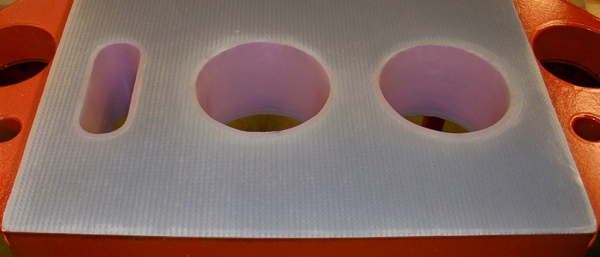
By lining steel or concrete structures, the good chemical resistance of plastics and the strength of steel or concrete are utilized. Linings can be carried out with almost all thermoplastic sheets or chemically resistant fiber-reinforced plastics.
Linings provide a cost-effective and long-lasting way to protect steel and concrete structures from chemical corrosion and wear.
By combining the chemical resistance of plastics and the strength of the load-bearing structure, a solution is achieved that withstands even the most demanding process conditions.
Key advantages of linings include:
Linings are used especially in tanks, basins, channels, process equipment, and reactors, where protecting steel or concrete is essential for safety and longevity.
PRP-Plastic has extensive experience in the design, manufacture, and installation of plastic and fiber-reinforced plastic linings. We combine chemical and mechanical material expertise so that the lining solution serves the process reliably throughout its entire life cycle.
We design and implement:
We use only certified materials and tested methods, and ensure quality at every stage of the work – from material selection to surface treatment and fastening of the lining.
The result is a solution that withstands chemical exposure, temperature fluctuations, and mechanical stress – safely and long-lastingly.
PP is a common and cost-effective lining material that withstands alkalis and organic solvents well.
Suitable for processes where the temperature stays below 100 °C and the chemical load is moderate.
Operating temperature: 0 °C – +100 °C
Applications: tanks, channels, basin linings, ventilation components
PVDF offers excellent resistance to chemicals and solvents.
Suitable for processes where cleanliness, tightness, and long-term temperature resistance are needed.
Operating temperature: –10 °C – +130 °C
Applications: linings for chemical tanks and reactors, pipelines
ECTFE withstands strong acids and solvents well and offers better mechanical durability at low temperatures than PVDF.
Especially suitable for corrosion-resistant structures in the chemical industry.
Operating temperature: –40 °C – +140 °C
Applications: tanks, reactors, process channels
PFA withstands almost all industrial chemicals and very high temperatures.
It is the best option for sites where process purity and chemical safety are critical.
Operating temperature: –200 °C – +260 °C (mechanically fastened)
Applications: linings for reactors, heat exchangers, and tanks
Fiber-reinforced plastic linings combine chemical resistance and structural strength.
In them, the inner surface is made of chemically resistant plastic (e.g., PP, PVDF, ECTFE, or PFA), and the outer surface is reinforced with fiberglass.
Operating temperature: determined by the inner lining
Applications: tanks, basins, channels, equipment linings
PRP is your choice when you want process equipment and piping to last year after year.


Headquarters
Moreenikatu 2 A, 04600 Mäntsälä
Keminmaa
Rajakankaantie 22, 94400 Keminmaa
Pori
Linjatie 4, 28430 Pori
Switchboard
029 006 250
Email
prpplastic@prpplastic.fi
Employee email addresses are in the format:
firstname.lastname@prpplastic.fi
