

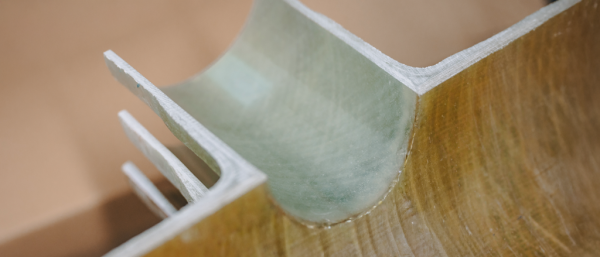
Fiber-reinforced plastics are an excellent choice when chemical resistance and structural strength are required. Their use enables efficient and flexible manufacturing of products of various shapes and complex designs.
Fiber-reinforced plastics, such as glass fiber reinforced plastics (GRP/FRP), combine the chemical resistance of plastics and structural strength in a way that makes them an excellent alternative to metals in demanding conditions.
They are widely used in tanks, ducts, piping, and ventilation systems where a lightweight but mechanically durable material is required.
Advantages of fiber-reinforced plastics include, among others:
In fiber-reinforced plastics, durability, lightness, and chemical protection combine in a unique way. They are an excellent solution for applications where traditional materials, such as steel or aluminum, suffer from corrosion or weight limitations.
PRP-Plastic has extensive experience in the design, manufacturing, and delivery of fiber-reinforced plastic structures for demanding industrial environments. We combine high material expertise and practical experience so that every solution meets both mechanical and chemical requirements.
We design and deliver:
We deliver only tested and certified materials, and our experts support the project from start to finish – from material selection to design and commissioning.
The result is a solution that withstands mechanical load, chemical stress, and time.
A fiber-reinforced plastic structure in which a polyester, vinyl ester, or epoxy matrix is reinforced with glass fiber.
The combination provides very high tensile strength and stiffness relative to weight.
Applications include, for example, piping, tanks, and ventilation ducts.
Operating temperature: up to +120 °C (depending on the matrix)
Applications: process industry, water treatment, chemical tanks, ventilation ducts
A composite structure in which the inner surface is made of a chemical-resistant plastic and the outer surface of a glass fiber reinforcement.
The solution combines the chemical resistance of the inner lining and the mechanical strength of the outer layer.
The dual-laminate structure prevents leaks, extends service life, and increases the stiffness of the structure.
Operating temperature: depends on the inner lining material (e.g. PP +100 °C, PVDF +130 °C, ECTFE +140 °C, PFA +260 °C)
Applications: chemical piping, tanks, ducts, process equipment
The use of carbon fiber as reinforcement enables very high mechanical strength and stiffness.
CFRP structures withstand dynamic loads and temperature fluctuations well.
Due to their high cost, they are used only in special applications.
Operating temperature: up to +180 °C
Applications: special structures, process components for high pressure or temperature
PRP is your choice when you want process equipment and piping to last year after year.


Headquarters
Moreenikatu 2 A, 04600 Mäntsälä
Keminmaa
Rajakankaantie 22, 94400 Keminmaa
Pori
Linjatie 4, 28430 Pori
Switchboard
029 006 250
Email
prpplastic@prpplastic.fi
Employee email addresses are in the format:
firstname.lastname@prpplastic.fi
