

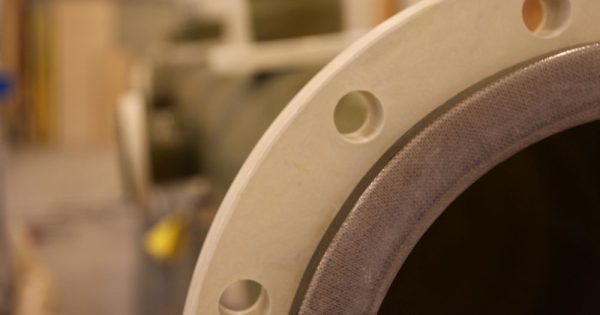
When the chemical resistance of thermoplastics is combined with the mechanical strength of fibre-reinforced plastics, an optimal structure is achieved for the challenges of various industries. With the right choice of thermoplastic or fluoroplastic, the best solution is achieved even for demanding conditions.
Composite structures (so-called dual laminates) offer a perfect balance between chemical resistance and mechanical strength.
In them, the inner surface is made of chemically resistant thermoplastic, such as PP, PVDF, ECTFE or PFA, and the outer surface of fibre-reinforced plastic (FRP), which gives the structure rigidity and strength.
This combination makes the structure:
Composite structures are an excellent option when traditional steel does not withstand chemical stress, but strength and dimensional stability are needed that thermoplastic alone does not provide.
Composite structures represent the pinnacle of materials technology for industrial use.
When you want a solution that combines the chemical resistance of plastics and the mechanical strength of fibre-reinforced plastics, PRP-Plastic’s composite structures provide reliability and long service life even in the most demanding conditions.
PRP-Plastic has over 30 years of experience in the design, manufacture and installation of dual-laminate structures.
We have delivered composite structures to many industries – the chemical, process and water treatment industries – where both structural safety and high chemical resistance are required.
PRP’s strength is a comprehensive approach:
The end result is a reliable and long-lasting structure that combines the best properties of materials – durability, strength and reliability.
A cost-effective combination in which PP provides good chemical resistance and FRP mechanical rigidity.
Suitable for general industrial applications where the temperature stays below 100 °C.
Operating temperature: 0 °C – +100 °C
Applications: tanks, channels, basin linings, process piping
Provides better resistance than PVDF to strong acids and at low temperatures.
An excellent solution for corrosion-resistant structures and tanks where the temperature varies.
Operating temperature: –40 °C – +140 °C
Applications: process tanks, channels, lined components
The highest-performing solution among fluoroplastics.
PFA withstands almost all industrial chemicals and even temperatures up to +260 °C when mechanically fastened.
Combined with an FRP structure, the result is a very durable and lightweight structure for extreme conditions.
Operating temperature: –200 °C – +260 °C
Applications: reactors, heat exchangers, very demanding chemical processes
PRP is your choice when you want process equipment and piping to last year after year.


Headquarters
Moreenikatu 2 A, 04600 Mäntsälä
Keminmaa
Rajakankaantie 22, 94400 Keminmaa
Pori
Linjatie 4, 28430 Pori
Switchboard
029 006 250
Email
prpplastic@prpplastic.fi
Employee email addresses are in the format:
firstname.lastname@prpplastic.fi
